
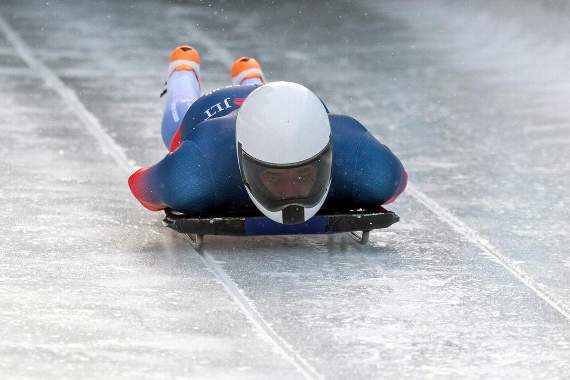
FOUR years ago, inspired by Lizzie Yarnold’s gold medal at the 2014 Sochi Winter Olympics, Marcus Wyatt applied to be a part of British skeleton’s Power2Podium programme.
Just months later, the former wide receiver with the Farnham Knights American football team found himself firmly on the road to Beijing 2022 – hurtling down an ice track at speeds approaching 70mph, face down riding little more than a tea tray.
Marcus, who turned 27 this month, has enjoyed a meteoric rise to the top of the skeleton ranks since hanging up his Knights uniform and is currently ranked ninth in the world for the hair-raising winter sport.
He narrowly missed out on a place at the last Winter Games in Korea earlier this year as Team GB opted for the greater experience of Jerry Rice.


-won-a-bronze-medal-at-the-World-Disability-Billiards-and-Snooker-Championship.jpeg?width=209&height=140&crop=209:145,smart&quality=75)
.jpeg?width=209&height=140&crop=209:145,smart&quality=75)
However, having watched his GB teammates Lizzy Yarnold, Laura Deas and Dom Parsons pick up medals in Pyeongchang, Britain’s most successful Winter Olympics ever, Marcus is determined not to miss out in 2022.
Earlier this year, the Herald caught up with Farnham’s Knights-turned-skeleton star to find out how the ex-American football speedster was finding life on the ice, and began by asking Wyatt about his experiences in Korea.
“The trip to Korea was part of the Team GB Ambitions programme,” he said. “They take a number of younger athletes who are in with a chance of competing at the next games out there to get an experience of it, to see what it’s like so that in four years time you are used to it. It gives you the chance to be overwhelmed when it doesn’t really matter.”
Many of the highlights of Britain’s 2018 Games came on the ice track in Pyeongchang, as skeleton supremo Lizzy Yarnold became the only British athlete to successfully defend a winter Olympics title, while GB’s Laura Deas and Dom Parsons surprised many by picking up bronze medals in the same sport – and Marcus was among those celebrating at the finish line.
“We train and compete alongside them day in day out, so it was really cool to be watching your friends compete at an Olympic games, and we were in the stands at the finish line when they won their medals,” he continued.
“It really gives you a lot of confidence that the people running this programme know what they are doing and are able to churn out medal winners every single Olympic games.
“Obviously a little bit of pressure comes with that, because you don’t want to be the one in four years time to not bring a medal back.
“If you asked me beforehand I don’t think I could be any more motivated, but actually going out there it gives you that little bit extra, especially on the hard days when you’re struggling a bit, and you can remember what it was like watching them. It gives you a little bit of a kick.”
Prior to joining the GB skeleton set up, Marcus combined his psychology studies at Swansea University with a successful season for the Farnham Knights American football team, playing at wide receiver – a position similar to a traditional rugby winger, with an emphasis on speed and handling skills.
As skeleton races begin with an explosive sprint, it was these transferable skills that stood him out as a potential skeleton star, and following a successful trial he decided to take up the sport full time.
“What skeleton look for is people who can start quickly, people who have come from a power or speed-based sport, and I was always a pretty good sprinter and that helped me obviously being a wideout,” he said.
What makes Britain’s success in Olympic skeleton racing all the more extraordinary is that the country does not boast a single track. But while the lack of a home track puts GB at a disadvantage, with British sliders clocking up as little as three hours of actual sliding time on the ice per season, the team has instead put more time and attention into choosing the right athletes, focussing on strength and speed training, and technique.
Aiding this is GB’s rollercoasteresque track at its base in Bath on which to practice the crucial fast start, and shave off time in an Olympic sport measured in hundredths of seconds.
Marcus said: “We spend all of our time in Bath where all the coaches and staff are based, so a lot of strength and speed work, gym sessions, swim sessions, building up your core muscles, and we’ve also got the push track. It’s essentially the first 50 metres of a track on rails so you can practice your start. It all comes back to the importance of being a quick starter.”
In a sport where potential disaster lurks around every corner, Marcus has been fortunate not to have suffered any major crashes to date. However, he has registered his fair share of bumps and scrapes, and vividly remembers his first time hurtling down the ice.
“You go out there for four or five days the first time without actually sliding – you get to know the track, the corners and which way they go, and all the little things, and you get a few little steers of things to do on the way down, and they spend a lot of time telling you about the line you’re going to take and where you want to go into each corner – but it just doesn’t happen like that.
“You start trundling along and then before you know it you’re absolutely flying, you’re out of control and hitting walls which no one ever said you’d hit and it’s just a bit of a blur really. But pretty much as soon as you get off you forget how deeply terrifying it was and you want to go again!
“You get to a point now where you finish sliding and the coaches will be stood at certain corners filming for video feedback, and they’ll say ‘I really like that line but next time if you could be an inch or two further right’ – and you’re like OK, I’m going at 70mph and he’s trying to be inch perfect! It’s pretty tough,” said Marcus, who hails from Honiton in Devon.
As lucky as he has been to avoid any major crashes, Marcus could count himself extremely unlucky to have missed out on a place at the Pyeongchang Games.
But Marcus, who will be 30 when the next winter Games come around, has continued to improve and with more spaces potentially up for grabs for GB’s men at Beijing, Marcus is hopeful of making the squad in 2022.
Comments
This article has no comments yet. Be the first to leave a comment.