
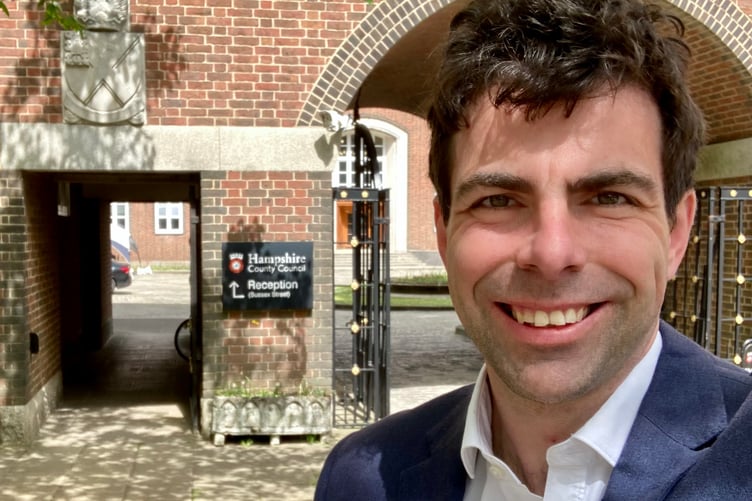
The Government's handling of local government reorganisation in Hampshire has descended into farce, leaving councils facing uncertainty and residents wondering who will pay the price.
What matters to me is having strong, democratic councils that deliver for residents, particularly across Whitehill, Bordon and Lindford.
Local government reorganisation is supposed to simplify the system, make it more cost-effective and deliver better value for council taxpayers.
I support those principles, but the detail is critical in determining whether proposed changes deserve support.
On March 25, the Government announced plans that would see Hampshire County Council (HCC) and East Hampshire District Council (EHDC) replaced by a single authority stretching from the Surrey border to the New Forest.
Many questioned whether such a vast council could genuinely deliver local democracy or remain financially sustainable.
Reorganisation is a once-in-a-lifetime opportunity to improve local government, not saddle residents with higher council tax bills for fewer services.
In June, HCC launched a judicial review challenging the Government's decision, raising questions about the reasoning behind it.
Despite these concerns, councillors and officers began preparing for the changes. This was a huge undertaking, requiring considerable time and resources.
Then, in September, the Government withdrew its March decision while declining to disclose the legal advice it had received concerning HCC's challenge.




I find it extraordinary that such a significant decision could be reversed so quickly.
Considerable time and money have been wasted on preparations that may prove unnecessary. Those resources could have been better spent improving local services.
On October 29, the Government announced its intention to make a fresh decision on Hampshire's reorganisation, with elections to the new unitary councils planned for May 2028.
HCC and EHDC would then be abolished in April 2029, while town and parish councils would remain unaffected.
EHDC elections are expected to proceed in May 2027, potentially giving councillors a final two-year term before the authority disappears.
Yet we do not know what the new council boundaries will look like. The Government could revive something similar to its original proposal or choose an entirely different arrangement.
This uncertainty makes it difficult for HCC and EHDC to plan for the future, particularly when Hampshire County Council faces serious financial pressures.
HCC had been preparing for its abolition in April 2028. Now it faces the prospect of continuing for another year, with all the financial and operational implications that brings.
The council provides vital services, including adult social care, children's services and highways maintenance.
Meanwhile, the Government's so-called Fair Funding changes are expected to remove approximately £28 million from HCC's funding in 2027–28.
Even annual council tax increases of 4.99 percent are struggling to keep pace with rising costs, particularly growing demand for adult social care, road repairs and inflation.
Residents deserve fair council tax bills and properly funded services, not continuing uncertainty over who will provide them.
Ultimately, the Government must address how adult social care is funded. Without reform, councils across the country risk financial failure.
That is the elephant in the room, and changing council boundaries alone will not solve it.
Comments
We've recently changed our login process. If you have an account for commenting, you will need to re-register on the login window.
This article has no comments yet. Be the first to leave a comment.