
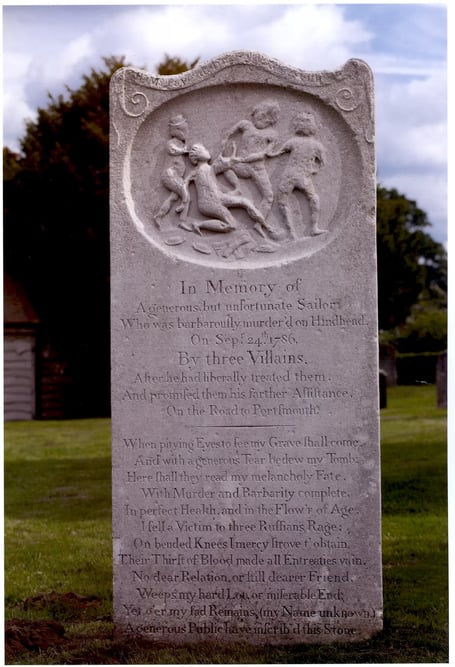
Debates over historical accounts are nothing new. Even events that took place centuries ago can still provoke disagreements over exactly what happened, where and when.
A case in point is a recent Peeps into the Past column about the notorious murder of the Unknown Sailor in Surrey in 1786.
The Thursley History Society has challenged our account of where the unfortunate sailor stopped for a drink before meeting his grisly fate.
Our article identified the White Lion at Moushill, but the society points to historical evidence identifying the Red Lion at Thursley. So which pub was it?
The story itself is one of the most notorious in Surrey's history.
On September 24, 1786, a sailor was making his way from London to Portsmouth to rejoin his ship when he encountered three other seafarers: James Marshall, Michael Casey and Edward Lonegon.
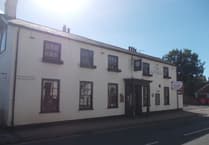
According to the account documented by the Thursley History Society, the meeting took place at the Red Lion Inn in Thursley, where the sailor generously bought the men food and drink.
The four subsequently left together, heading towards Hindhead.
But the sailor's generosity was repaid with shocking brutality. His companions attacked and murdered him, stripped him of his clothes and abandoned his body in the Devil's Punch Bowl.
The killers continued along the Portsmouth Road but were arrested a few hours later while attempting to sell the stolen clothing at the Sun Inn in Rake.

The crime was reported in the Hampshire Chronicle on October 2, 1786, which described how the victim's body had been discovered by people crossing Hindhead.
The three men were tried at Kingston Assizes six months later and, on April 7, 1787, were hanged in chains on Gibbet Hill, close to the scene of their crime.
The Thursley History Society has assembled an extensive collection of material relating to the murder, including contemporary newspaper reports, assize records, historic illustrations and subsequent research.
Its account identifies the Red Lion as the place where the sailor met his killers, an interpretation also reflected in other local histories.
The geography certainly supports the argument. The Red Lion stood on the old Portsmouth Road, a natural stopping point for someone travelling towards the naval port.
The pub itself survived long after the murder, finally closing in 1958. The building was subsequently converted into two cottages.
Yet an interesting complication emerges from another authoritative source.
Historic England's official listing for the former White Lion at Milford also links that building to the murder.
According to its account, the sailor is thought to have met the three men at the White Lion before continuing with them to Thursley, where they stopped at the Red Lion for further drinks.
In other words, it is possible that both pubs featured in the unfortunate sailor's final journey.
The Thursley History Society's research provides an opportunity to examine the story through a substantial collection of surviving documents.
And the identity of the victim himself remains another mystery.
Although remembered for generations simply as the Unknown Sailor, researcher Peter Moorey suggested that he might have been Edward Hardman, born in Lambeth in 1752.
His theory has never been conclusively established.
What is beyond dispute is the lasting impression the murder made on the surrounding countryside.
The sailor was buried in Thursley churchyard, where villagers paid for a gravestone commemorating his fate.
Another memorial, known as the Sailor's Stone, was erected near the scene of the murder by James Stillwell of nearby Cosford Mill.
In 1851, Sir William Erle paid for a granite Celtic cross on Gibbet Hill, reportedly hoping to dispel the fears and superstitions associated with the place.
All these memorials survive, reminders of a crime that shocked the area more than two centuries ago.
The disagreement over the White Lion and Red Lion is therefore just one of several mysteries surrounding a case that has fascinated generations of historians.
Comments
We've recently changed our login process. If you have an account for commenting, you will need to re-register on the login window.
This article has no comments yet. Be the first to leave a comment.