
A thunderous explosion shook an Iowa town on a Saturday afternoon in May 1879, rattling windows and sending cattle stampeding as a blazing object broke apart in the sky.
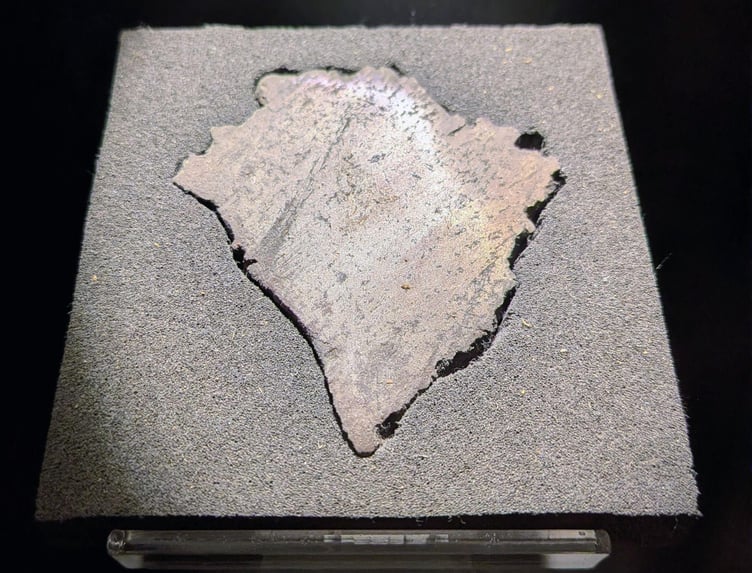
The Estherville meteorite scattered fragments across the surrounding countryside. Nearly 150 years later, one of those pieces can be seen in Haslemere Educational Museum.
Historical accounts describe china shifting on cupboard shelves, doors shaking and window panes breaking as the meteorite arrived on May 10.
Witnesses saw a ball of fire travelling from southwest to northeast before separating into large pieces. Boys near a lake reported its waters being peppered with fragments that sounded like hailstones.
A railway surveyor near Jackson, Minnesota, described seeing the object emerge from a storm cloud, brilliantly white. Two travellers crossing the prairie beneath it reported watching the pieces separate, leaving ribbons of vapour that formed a crow’s-foot pattern high overhead.
The largest piece, weighing more than 400 pounds, buried itself on the Lee farm north of Estherville. Eight young men initially struggled to recover it from the mud and water before hiring well digger George Osborn.
Once recovered, the meteorite became a travelling attraction. The group loaded it into a wagon and set off across Minnesota with a sign announcing: “I am the Heavenly Meteor.”
But its journey soon became a dispute over ownership. Hearing their claim was being challenged, the men returned to Estherville, wrapped the meteorite in quilts and buried it in Osborn’s cornfield.
It was later moved to one of their homes before an attorney claiming an interest in the farmland obtained a legal order allowing him to take it. The specimen was subsequently sold to the British Museum.
Other substantial pieces were recovered nearby, while smaller fragments found their way into museums, institutions and private collections. Some were even fashioned into finger rings.



The fragment now displayed in Haslemere’s Geology Gallery offers a link to an event that astonished Victorian observers and prompted an enthusiastic search for pieces of the fallen object.
Contemporary English newspapers described an “Extraordinary Meteoric Shower”. The fragments were reported to be very black and well-crusted, with metal that could be polished to a steel-white or silver-grey finish.
Estherville is a stony-iron meteorite, containing both rocky silicate minerals and metallic iron-nickel. Meteorites help researchers understand how the solar system developed, with most originating from asteroids and a smaller number from Mars or the Moon.
The British Museum acquired its first three meteorites in 1802, when people were beginning to accept that these objects were natural, rather than supernatural, phenomena.
Its collection was transferred to what is now the Natural History Museum in 1883. The museum also displays material from the Winchcombe meteorite, which fell in Gloucestershire in February 2021.
Those fragments were collected quickly, limiting contamination and making them particularly valuable for research.
Haslemere’s much older arrival provides a historical connection to this October’s World Space Week, running from October 4 to 10 with the theme Rocket Revolution.
Guildford High Street will host space-related activities on October 10, with family events coordinated by the University of Surrey and the Institute of Physics.
Stargazers may also catch sight of the Draconid meteor shower during the week. These meteors appear to radiate from the constellation Draco and are best viewed in the early evening, just after nightfall.
Later in October, the Orionid shower offers another opportunity, particularly after midnight. Its fast, bright meteors appear to radiate from Orion as Earth passes through debris left by Halley’s Comet.
Often called shooting stars, meteors are streaks of light produced when fragments of space rock enter Earth’s atmosphere at high speed. Any material that survives and reaches the ground is known as a meteorite.
Visitors to Haslemere can see one such survivor – a small reminder of the extraordinary afternoon when pieces of space fell across an Iowa farming community.
For more information about Haslemere Museum, visit www.haslemeremuseum.co.uk.
Comments
We've recently changed our login process. If you have an account for commenting, you will need to re-register on the login window.
This article has no comments yet. Be the first to leave a comment.