

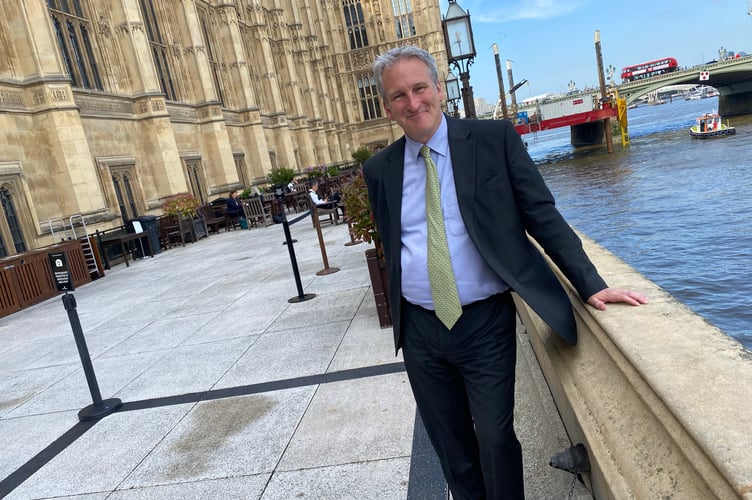
I recently met pupils from local schools to discuss their television viewing habits as part of the Culture, Media and Sport Committee’s inquiry into children’s TV.
Simple polls in the room showed almost everyone regularly watched platforms such as Netflix, Apple TV and YouTube, but only a small minority said they regularly watched programmes live on the BBC.
The concept of watching a sequence of different programmes curated by someone else with set start times is something that is unfamiliar to much of a generation.
Alongside the inquiry into children’s TV, the committee chaired by fellow Hampshire MP Caroline Dinenage – is also examining the BBC’s Royal Charter. The Charter sets out how the BBC is governed, funded and regulated, and is reviewed every 10 years.




Few national institutions provoke as much debate as the BBC. Questions about its future role in public service broadcasting are now more open, and more pressing, than at any time, certainly in my memory.
The BBC’s reputation has taken significant knocks in recent years. I was particularly shocked by the Capitol Hill Trump speech edit. People have more choice now, and more have turned away from it.
The BBC is also having to adapt to changing patterns of media consumption. Audiences increasingly consume news and entertainment in clips and snippets through social media rather than watching or listening to full programmes.
Viewing habits are changing rapidly. Unsurprisingly, many ask why they should continue paying for the BBC when so much of the content they watch comes from elsewhere.
Yet despite these challenges, the BBC continues to play a uniquely important role. In an era of misinformation and disinformation, ranging from foreign state propaganda to the elevation of clickbait and ragebait, its role matters more than ever.
This is especially true internationally with the World Service. In many developing nations, reliable journalism can be a vital safeguard against instability and political manipulation. At the same time, large state-backed broadcasters such as Russia Today and China’s CGTN are expanding aggressively, seeking to shape global narratives and influence audiences around the world.
For all its faults, the BBC remains one of Britain’s most significant cultural institutions and I believe strongly we would be much worse off without it.
Notwithstanding the missteps, the BBC is still the most trusted source of news. Alongside local papers, like this one, local TV and radio play a unique role. South Today and other regional news programmes still form the most-watched news slot of the day.
The Charter review provides an important opportunity to consider what the BBC should look like in the future and how it can best serve audiences in a much-changed media landscape.
It will be our biggest inquiry of 2026 on the committee, and I am much looking forward to it.
Comments
This article has no comments yet. Be the first to leave a comment.