
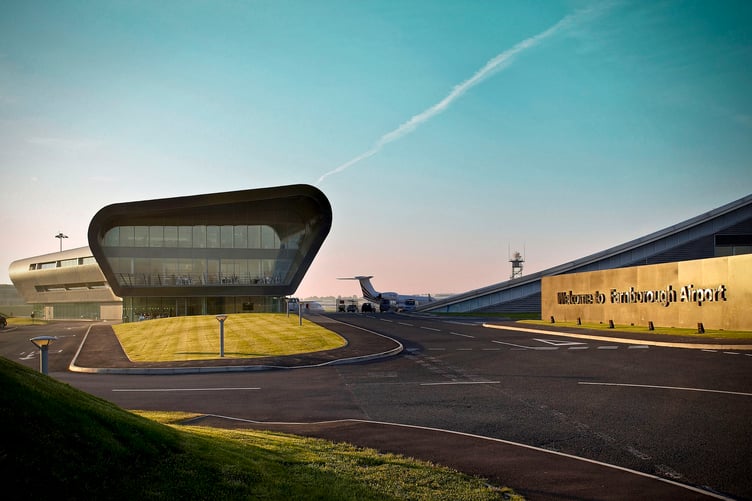
Opposition is continuing to proposals at Farnborough Airport that would allow more weekend and bank holiday flights and changes to aircraft size limits.
Residents, environmental groups and local politicians say the plans could increase noise and disruption for surrounding communities.
Campaigning against the application are groups including the Farnborough Noise Group and Blackwater Valley Friends of the Earth, supported by councillors from neighbouring authorities.
Critics argue that current flight levels are already intrusive at weekends and that the proposed changes would intensify activity at times when residents expect respite.



Farnborough Airport has rejected the claims, saying the proposals would not redistribute flights into weekends or increase noise, and that the application is intended to reflect long-term operating patterns while remaining within existing annual limits.
The planning application, submitted to Rushmoor Borough Council, seeks to vary several conditions attached to the airport’s existing permission. While the overall annual cap would remain at 50,000 aircraft movements, the airport is asking to increase the limit on non-weekday movements from 8,900 to 13,500 a year.
The airport says this reflects the fact that around 27 percent of flights already take place on non-weekdays and that the current limit, set in 2011, no longer matches how business aviation operates across a seven-day week.
The application also proposes changes to aircraft weight categories. It would amend the lower threshold of the restricted category from 50,000kg to 55,000kg, allowing newer aircraft which the airport says are quieter and more fuel-efficient to operate without restriction. The number of heavier non-weekday flights in the 50,000kg to 80,000kg category would increase from 270 to 405 a year, remaining within an existing cap of 1,500 movements.

Cllr Julian Spence, Waverley Borough Council member for Hindhead and Beacon Hill and a resident of Churt, has been encouraging residents to make their objections clear to Rushmoor.
He said: “Residents who are already suffering from being under the 2020 flightpaths will bear the impact of this ill-considered expansion, with additional noise and pollution ruining their weekends.”
Farnham and Bordon MP Gregory Stafford has submitted a formal objection to the proposals to Rushmoor Borough Council.
Mr Stafford acknowledged the airport’s aim of supporting commercial growth but said this must be balanced against the effect on residents beneath established flightpaths, particularly at weekends.
He said: “Although the overall annual movements cap is retained, this clearly represents a substantial redistribution of activity into weekends and public holidays, combined with a significant intensification of the heaviest category of aircraft during those same sensitive periods.”
Responding to Mr Stafford’s comments, a Farnborough Airport spokesperson said there was no redistribution of flights to weekends and that the proportion of flights across the week would remain the same as currently operated.
The spokesperson said there was also no intensification of the heaviest aircraft category, adding that the proposal instead allows marginally heavier but less noisy and more efficient aircraft.
He said: “Farnborough Airport is the UK’s largest business aviation airport and is an essential part of the London and South East airport system. Smaller-lighter aircraft choose to use Farnborough due to its proximity to London and its excellent road access links.
“Currently, Farnborough Airport serves over 800 airport connections across the world, with 80 percent of its flights being directly or indirectly related to business use. As such, Farnborough has a demonstrable role in creating economic growth and supporting inward investment into the UK.
“Our planning application seeks to address the long-term demand for these flights as they become increasingly displaced from traditional commercial passenger airports and as they themselves become increasingly capacity constrained.”
The spokesperson said the application was seeking to amend an existing planning constraint on the number of non-weekday flights the airport is permitted to handle.
He said: “Approximately 27 percent of our flights occur on a non-weekday, and the planning application is simply seeking to maintain that proportion of flights going forward, consistent with expected demand which is anticipated to be evenly spread across the entire seven-day operational week.
“This requires a change to the flight limit which is in place today, which allows only 8,900 flights on non-weekdays within the airport’s allowable 50,000 total annual limit. The application seeks to increase the non-weekday limit to 13,500, which is 27 percent of the 50,000.”
The spokesperson said Farnborough Airport does handle some leisure flights, but added these were “very much in the minority”.
He said: “There is no evidence to suggest that the split between business and leisure flights is any different on non-weekdays compared to weekdays, and given the ultra-premium nature of such flights, it is logical and sensible to assume that leisure travellers who use such flights are not constrained to the rigidity of a traditional five-day working week.
“The primary purpose of the planning application is to ensure Farnborough Airport can meet the future demand for flights from smaller-lighter aircraft over the longer term.
“This is principally driven by the connectivity and assurance advantages conferred to corporations, businesses and entrepreneurs who are the primary users of Farnborough Airport, and the economic opportunity and productivity gains which they benefit from.”
The spokesperson added that Farnborough Airport supports 3,000 jobs locally, while flights from the airport generate £1.6 billion of gross value added to the UK economy every year.
Comments
We've recently changed our login process. If you have an account for commenting, you will need to re-register on the login window.
This article has no comments yet. Be the first to leave a comment.