
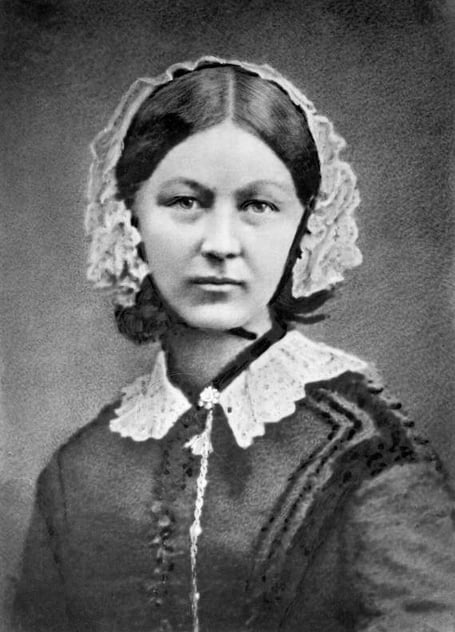
The most influential person with a link to Farnham is surely Florence Nightingale, ‘the lady with the lamp’, writes Roy Waight.
That she founded modern nursing is well known. Less well known are her other accomplishments.
She was a good statistician who pioneered the lucid presentation of complex statistical material. She argued passionately that basic hygiene and cleanliness be extended to civilian, and not just military, life.
Through doggedness and her many contacts, not least with Queen Victoria, she eventually succeeded. The 1875 Public Health Act can be seen as a lasting tribute to Florence Nightingale.



Her ideas on sanitation were subsequently promoted throughout the Empire, particularly in India.
In the calculus of human suffering, Florence Nightingale is up there with Sir Edward Jenner, Sir Alexander Fleming, and Lord Lister as one of the great saviours of human life.
Her connections to Farnham were significant. One of Florence’s aunts had married the rich landowner, George Nicholson, who lived at Waverley Abbey. Every Christmas, the young Florence would accompany her family there. It was at Waverley Abbey House that the 16-year-old Florence first heard the voice of God telling her he had a special role for her.
The Nicholsons’ beautiful daughter, Marianne, married the brilliant engineer, Captain Douglas Galton, who went on to provide Florence with much help when she got to Scutari in the Crimea. The course of Florence’s life was largely determined during her stays with the Nicholsons.
The second connection concerned the Revd Richard Garth who lived at Brightwells. Garth had four daughters and one of them, Frances, married Colonel Patrick Paget and they subsequently made Brightwells their home.
Florence became great friends with the Paget family. Col Paget’s first daughter was named Florence in her honour. Florence Nightingale became her godmother.
As she grew up, Florence Paget kept her godmother abreast of Farnham news. It is said that Florence spent the night before embarking for Scutari in October 1854 at Farnham. The third connection involved The Farnham Workhouse Infirmary. An article published in the Lancet in 1867 led to the ‘Farnham Workhouse Scandal’.
Conditions there were terrible and this led Florence to turn her attention to workhouse infirmary reform. When the rich brewer, George Trimmer, built a new Farnham hospital in 1895, she was delighted. Later she gave a lovely silver communion set as a gift for the nurses and patients of Farnham Infirmary.
The fourth connection concerns Sidney Herbert, an admirable Minister for War, who fell in love with Florence. She rejected him and he subsequently married Elizabeth, the daughter of Annabella Vernon of the prominent Farnham family, the Vernons.
Then fifth connection concerned Harry Verney, another of Florence’s rejected suitors. He turned his attention to Florence’s artistic sister, Parthenope, and offered her marriage. She accepted. Their great grandson was Sir John Verney, the prominent Farnham character who lived for many years at Runwick House.
Last but not least, when the elderly Florence was bed-bound in her house in Mayfair, she befriended a young and very remarkable Christian socialist minister, Thory Gage Gardiner, who had been Rector of Farnham between 1895 and 1905. Florence Nightingale affected him deeply.
It was Gardiner who pressed for a girls’ grammar school in Farnham. I like to think he was influenced by Florence, who believed all her life in the importance of educating girls. When Florence Nightingale died in 1910, she was buried at the beautiful little church at East Wellow, near the family home at Embley. She asked that the Revd. Thory Gage Gardiner officiate with the local minister.
It is very fitting that on 12th May, International Nursing Day, the silver communion set given to Trimmer’s Hospital, will find a permanent home at Farnham Museum.
It will form the centre piece of a new display focusing on health, hygiene and death in Victorian Farnham.
Thanks are due to Museum Manager Lauren Wayland, Frimley NHS Foundation Trust, Farnham Society and the Farnham and District Museum Society, who have made this possible.
Comments
We've recently changed our login process. If you have an account for commenting, you will need to re-register on the login window.
This article has no comments yet. Be the first to leave a comment.