
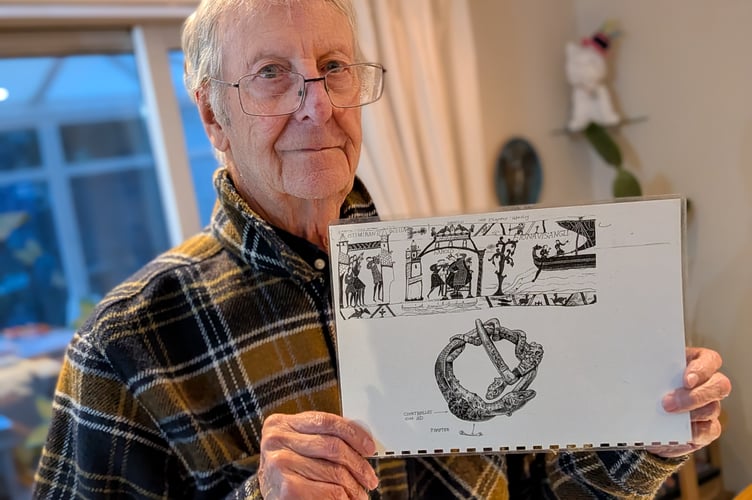
A celestial anniversary and the forthcoming return of a cultural artefact has brought back memories for a detectorist who uncovered a remarkable find from the Early Middle Ages four decades ago.
People looked to the skies in wonder and dread in the 11th century as Halley’s Comet moved through the night skies during the early months of 1066.
It certainly caught the imagination of people at the time, with William of Normandy considering it a good omen for success in his fight for the crown.
And lo behold, it was also depicted on the Bayeux Tapestry, appearing as a “hairy star” above King Harold in an omen of “impending divine punishment”.




The news that the 70-metre artwork will be displayed in the British Museum later this summer in a once-in-a-lifetime exhibition has excited Peter Beasley.
The treasure hunter from Waterlooville made national headlines in 1989 when he discovered a talisman brooch from the period while searching and excavating the site of William’s royal Palace of Appledoram, near Buriton.
Many Normans still believed in Norse mythology and believed the comet was a representation of the dragon Jormungandr – with the brooch that Mr Beasley uncovered including a reference to the celestial event.
“If you look at the brooch I found near Buriton there’s a dragon,” said the detectorist from Waterlooville, who has found countless treasures in the fields of East Hampshire over the years.
“It’s near enough exactly the same image that appears on the Bayeux Tapestry. So when I heard it is coming here, I was instantly reminded of this find.”
The brooch was later sold to an American buyer for a considerable sum through a London auction house, while Mr Beasley will be hoping for more exciting finds with a big expedition lined-up in the Solent area.
Comments
We've recently changed our login process. If you have an account for commenting, you will need to re-register on the login window.
This article has no comments yet. Be the first to leave a comment.