
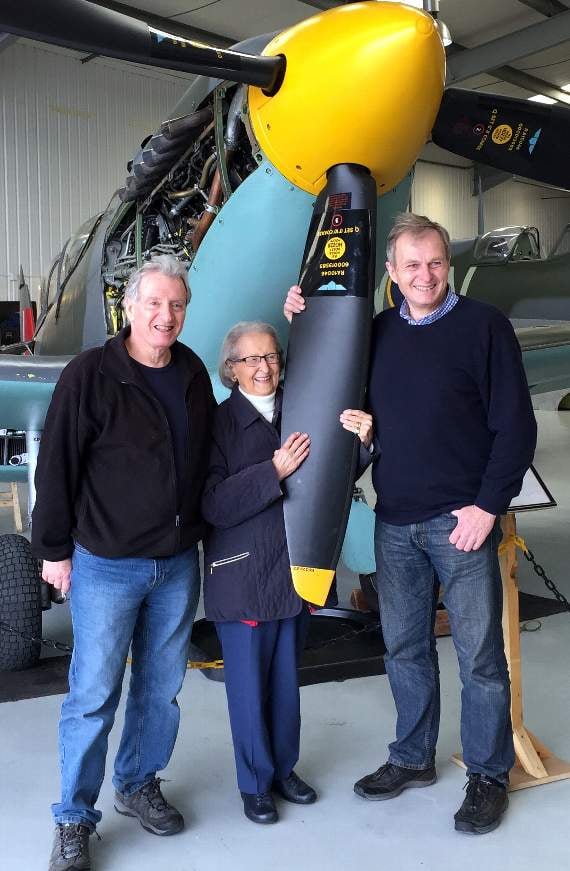
A FORMER WWII Spitfire mechanic enjoyed a dream come true, thanks to Haslemere resident Mick Bradford.
June Newton, 92, is a first cousin once removed of Wilfred ‘Jimmy’ Cleall, who was one of three airmen who lost their lives when their Douglas Boston night-fighter crashed into the Hindhead Road, near Shottermill Club, on September 22, 1942.
Determined their memory should be officially commemorated, Mick organised a memorial near the spot in Wey Hill, which was unveiled in 2013.
Last September, he staged a Spitfire tribute, following a service of remembrance, in which Biggin Hill Heritage Hangar pilot Richard Verrall performed a flypast over Gibbet Hill.




Mrs Newton was a special guest at last year’s commemoration and told Mick how much she had enjoyed watching the Spitfire, because of the wartime memories it brought back.
Mick said: “June was so taken by the flypast and the Spitfire replica displayed at Gibbet Hill, I thought she should be reacquainted with the real thing.
“She worked on Spitfires in WWII and one of her jobs was lying on the tail of the plane, while the pilot revved the engine.
“On one occasion, the pilot forgot she was there and she had to bang on the plane to stop him taking off.
“June remembers visiting Jimmy’s house and seeing him there.
“Spitfires were her life and she was so pleased when I was able to arrange with Richard’s help for her to go to Biggin Hill Heritage Hangar to see the Spitfire and sit in the cockpit.
SPITFIRE HISTORY
•The single seater aircraft came in many varaints for use by the RAF and the Fleet Air Arm.
•It was first designed by RJ Mitchell at Supermarine Aviation Works and made its first flight in 1936 at Eastleigh Aerodrome, near Southampton..
•Between 1938 and 1948, 20,351 were built – around 50 are still airworthy.
•They cost around £750k to build at today’s prices.
•Rolls-Royce’s Merlin engine flew at 360mph but the fastest speed ever achieved by the legendary fighter was 608mph.
•They were finally taken out of service by the RAF in 1954
Comments
This article has no comments yet. Be the first to leave a comment.