
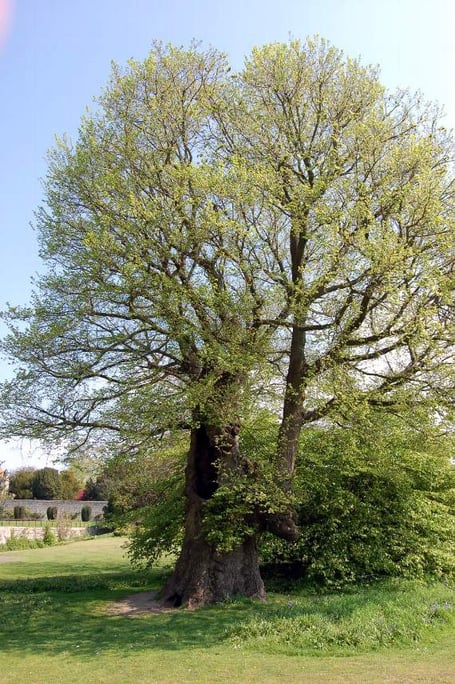
THE Conservation Foundation has launched a citizen-science initiative to investigate the state of the English elm.
While many people are of the opinion that Britain’s elm trees have disappeared, the charity believes there could be more healthy elms in our parks, gardens and countryside than we think.
Following the impact of Dutch elm disease which, from the 1970s, is said to have killed over 60 million British elms in two epidemics, the foundation believes there are trees that have survived the epidemic, and is developing an accessible, public database that records the state of the elm population and potentially disease-resistant trees - information that can be used to support future research.
It has set up a new interactive map to help understand the state of the elm population, and to identify surviving elms across the UK.


Launched in 1982, to help people take practical action in their community to support and understand the environment around them, The Conservation Foundation is working on a wide range of projects, among The Great British Elm Search.
Featured in art, music and poetry the elm has a rich heritage and now modern technology is bringing a new chapter to the Great British Elm.
With the arrival of spring and the distinctive bunches of bright green seed clumps that make elm trees instantly recognisable, the foundation is calling on the British public to become ‘elm detectives’. They are invited to join the search for the UK’s elms, many of which grow unrecognised in our towns, parks and countryside, and to record them on the new crowd-sourced map at www.conservationfoundation.co.uk/elms/map
The project is asking ‘detectives’ to record sightings of mature elm trees, supported by photographs of the tree (leaves, bark, shape) with its location and as much other information as possible.
The elm map is populated so far with almost 150 elms identified by experts and enthusiasts, and the hope is that these surviving specimens could be disease-resistant.
Postings are being moderated by a number of elm experts and researchers who will identify the species - among them Peter Bourne, supporter of the National Elm Collection in Brighton.
Elms have been part of The Conservation Foundation’s history and an elm planting ceremony in October 1979 in Harlow, Essex, led David Shreeve and David Bellamy to launch the charity in 1982. Over the years since thousands of elms have been planted, including a disease resistant Sapporo Autumn Gold planted by The Duke of Edinburgh in Windsor Great Park, where it still flourishes.
Most recently the Great British Elm Experiment has led to some 3,000 plantings of elms micro propagated from mature parent trees in schools and communities around the UK and has engaged and interested a new generation in this much-loved tree, which has been so much part of British culture over centuries.
Conservation Foundation director David Shreeve said: “Our foundation grew out of an elm project over 30 years ago and since then we have undertaken a number of initiatives to show that, despite the huge loss of elms due to disease and development, they are still very much around.
“Thanks to a number of enthusiasts who keep alive an interest in native and new elms and the biodiversity elm trees support, they are ensuring that elms are not a just tree of the past only featuring in memories, poetry and paintings.
“Now, with modern technology, anyone will be able to see just where the UK’s elms are and hopefully, as a result, even more healthy, mature trees will be discovered and added to our map.”
Sir Harry Studholme, chairman of the Forestry Commission, added: “Elms for centuries gave character to the English landscape. The experience of increasing incidences of tree disease in other species over the last few years has given even greater importance to understanding the resource we have left, how we can protect it and even how we might expand it for future generations.”
The Conservation Foundation Great British Elm Search map is supported by The Tanner Trust, The Berkeley Reafforestation Trust and private individuals.
For more details, visit conservationfoundation.co.uk.
Comments
This article has no comments yet. Be the first to leave a comment.