
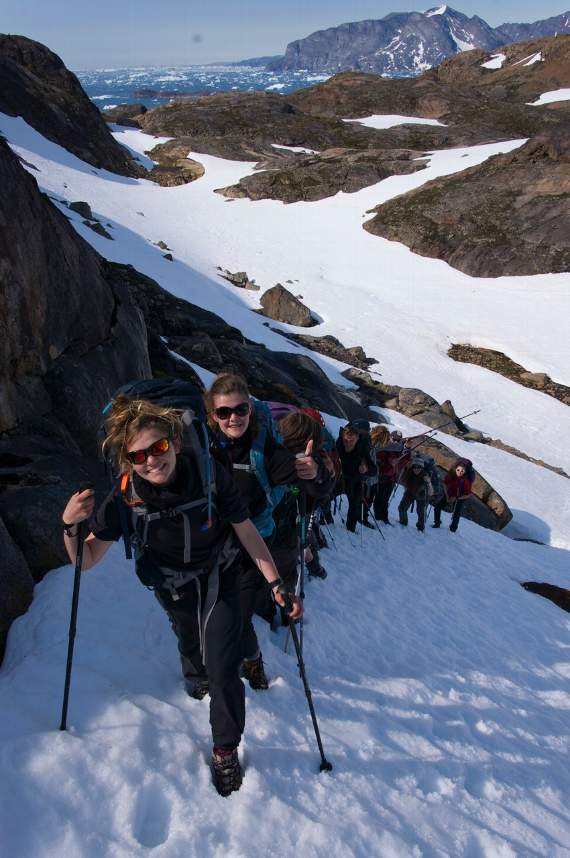
FORTY-two intrepid young explorers from Bohunt School in Liphook enjoyed unforgettable journeys to Greenland or Kyrgyzstan with stories of polar bear dens, camping on glaciers, crazy Kyrgy markets and lost guides, last summer
It was truly a once-in-a-lifetime experience for the four teams of 14 to 16 year olds.
After a build-up day in school when kit was checked and packed, the team from Bohunt School departed from London Gatwick for Reykjavik in Iceland.
They pitched their tents at 2am under a vibrant orange sky, grabbed a few hours sleep and then headed on to the island of Kulusuk, off the south east coast of Greenland, inside the Arctic Circle.
 Dreaming of a green Christmas as Petersfield group offers discounted fruit trees
 VIDEO: Merry motorcade as thousands around East Hants and Sussex cheer on tractor run
 Dazzling Christmas convoy to hit the road as Tractor Run returns to Petersfield area
 Thousands of Frimley Health staff on duty this Christmas Day
There the team split, sorted their food, fuel and kit, which included shotguns. They were necessary to increasing polar bear activity caused by the sea ice right in close to the land.
Flying into Kulusuk proved to be exciting due to the turbulence as well as providing spectacular views of seemingly tiny icebergs below.
The next leg of the journey saw the teams weaving in and out of icebergs aboard a small boat laden with crew and kit, which took them to a remote beach from where they set out to trek to their various science fieldwork sites.
This first trek was physically hard due to extremely heavy packs weighing more than 20kg, steep gradients and rocky terrain, but the students were all amazed at how well they coped, even with annoying mosquitoes.
The team was completing scientific research in conjunction with the Langton Star Centre for CERN – the European Organization for Nuclear Research – on background radiation levels. They had to carry the weather station only a short distance, set up and leave for the duration of the trip.
But the highly sensitive radiation detectors, laptops, solar panels and external batteries had to be carried with them wherever they went, be that to a mountain peak or across a river.
All data and analysis will be used by CERN as part of the CERN@ School project and by future Bohunt students as radiation, extreme environments and climate change are all key parts of the curriculum.
One of the highlights of the trip was camping on a glacier – however it did take two attempts.
With the aid of crampons, the team carefully picked their way through the crevasses and found a flat area on the first glacier where they could set up camp and have dinner.
About two hours later, just as students were settling down, a freshly dug bear den was spotted just 200 metres from the camp, which meant everyone had to be evacuated after just five hours, as after further inspection the bear den was not far away.
The team was forced to flee in a hurry, packing up all personal belongings and equipment within less than 45 minutes.
After a two-day trek on the neighbouring island of Ammassalik, the team reached the town of Tasiilaq, which provided a change of scenery, where houses were painted in bright bold colours.
Students had a tour around the village, met local people, who created and sold necklaces made from bone and headed to the village museum to learn about the history of Tasiilaq.
The final phase of the expedition was an ascent of a large mountain peak. It provoked a mixture of reactions from the students. For some it presented a challenge, while for others it seemed a daunting, impossible task.
The climb itself was the hardest terrain faced on the entire trip, involving constant climbing over extremely large rocks, some free-hand climbing on very steep and occasionally vertical slopes. Superb team spirit saw all students reach the high point and drink in the views.
After spending a couple of days in Iceland and some much needed rest and relaxation, which included a visit to the famous Blue Lagoon, it was time to depart and return home.
For that group of explorers, the memories and life skills they learned on the trip will stay with them for a lifetime, as will the feeling of incredible remoteness, being in the wilderness for three weeks, and the sense of trust and responsibility.
The students have already presented their expedition at a research symposium at the University in London, and in a school assembly, and in November they opened the Royal Geographical Society’s Explore Conference with a lecture entitled ‘Inspiring the next generation; why expeditions for the young, and young at heart, matter’.
Comments
This article has no comments yet. Be the first to leave a comment.