
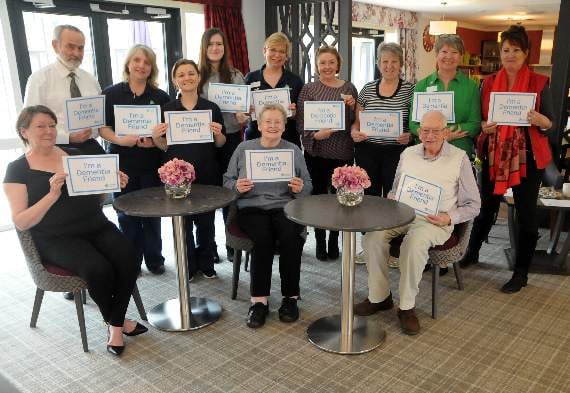
BRAMSHOTT Grange Care Home welcomed visitors to its Dementia Awareness Day, offering a ‘virtual dementia tour’ where they could experience for themselves what living with the disease may be like.
The Virtual Dementia Tour was invented 20 years ago in America by world-renowned geriatric specialist and author PK Beville, and is medically and scientifically proven to be the closest a person with a healthy brain can get to experience what dementia might be like.
By understanding dementia from the person’s point of view it is aimed to change how to treat sufferers, reduce issues and improve their lives.
The tour was created as a sensitivity training programme to help in the area of dementia care and is now a comprehensive training programme designed to prepare healthcare providers, families and community leaders for the growing numbers of people with dementia.

The disease can leave a person scared, intimidated, confused as well as feeling vulnerable and the tour, conducted under supervision inside a specially designed bus, aims to deliver the experience for staff, relatives and visitors.
In addition to the tour, staff at Bramshott Grange held a Dementia Friends information session on behalf of the Haslemere-branch of the Alzheimer’s Society, where guests learned about five key messages which go on to help dispel some of the myths and stigma that surround the disease.
They include that demntia is not a natural part of ageing, is not caused by diseases of the brain and is not just about losing your memory – it can affect thinking, communicating and doing everyday tasks.
The society pointed out it is possible to live well with dementia and that there is always more to a person than the dementia.
Libby Barrett, home director at Bramshott Grange, told The Herald: “Everyone who experienced the Virtual Dementia Tour said how powerful and helpful it was in assisting them to understand more about their loved one’s illness and is a ‘must have’ training for every care professional or family member that wants to understand dementia by walking in the shoes of a person with the disease.
“We will definitely have the tour bus come back again so that more people can take part next time.”
East Hampshire MP Damian Hinds, the Gvernment’s Education Secretary, has already become a Dementia Friends champion, after his mother was diagnosed with the disease, which provided him with an invaluable understanding of what it is like to live with dementia.
He supports the Alzheimer Society’s aim in wanting to create the most dementia friendly country in Europe by 2020 and has been holding Dementia Friends information sessions over the last two years.
He has also been working with the members of Dementia Friendly Petersfield to support the initiative to increase awareness and understanding of dementia across the town, so those affected feel more supported by the businesses and services they rely on, which is something Allison Purkiss, community engagement manager at Bramshott Grange Care Home, is hoping to introduce to the parish.
Dementia symptoms may include memory loss and difficulties with thinking, problem-solving or language as well as changes in mood or behaviour which are often small to start with, but for someone with dementia they become severe enough to affect daily life.
The specific symptoms that someone with dementia experiences will depend on the parts of the brain that are damaged and the disease that is causing the dementia.
More than 26,000, people in Hampshire have a form of dementia and across the UK a new person develops it every three minutes.
Despite its growing prevalence, public understanding of the condition remains poor.
It has been claimed that dementia kills more people than heart disease or cancer and therefore is the largest killer in the UK.
Statistics show one-in-three people born in the UK in 2015 are expected to die from dementia as they get older.
With such statistical evidence to hand, it is vital the quality of training is improved and carers and family members must focus on what dementia is like for the person affected, the experts say.
Comments
This article has no comments yet. Be the first to leave a comment.