Water is a commodity we take for granted and one which, particularly bearing in mind the amount of rain we have been having recently, we spend an amount of time complaining about. Here in South West Surrey, all being well, we simply turn on a tap to access this essential life-source, but of course that has not always been the case.
As we reflect on World Water Day, we at Haslemere Museum thought we would take look at some Haslemere water-based factoids and consider how dramatically daily life has changed within just a few generations.
For Queen Victoria’s reign, water was sourced from wells and rainwater collection. Accessing clean water was a daily task rather than an automatic convenience, and its quality could never be taken for granted. By 1898, larger houses in Haslemere were able to draw water from their own private wells, a mark of relative privilege and practicality.
Other properties relied on public standpipes, simple but vital fixtures where water could be collected and carried home. Among these were two supplied under a lease granted by James Stewart Hodgson of Lythe Hill around 1890, allowing water to be drawn from Pylewell (or Pile Well), a dipping well located on Lower Street. Although that well is no longer in use, the well keeper’s cottage still survives, tucked away near Chapel Steps as a quiet reminder of this earlier system.



One of the town’s historic wells also remains in place today, off the High Street along Well Lane. But a public health warning still applies – it is very much not suitable for drinking. These wells once formed the backbone of local supply, serving much of the town before the arrival of a piped system.
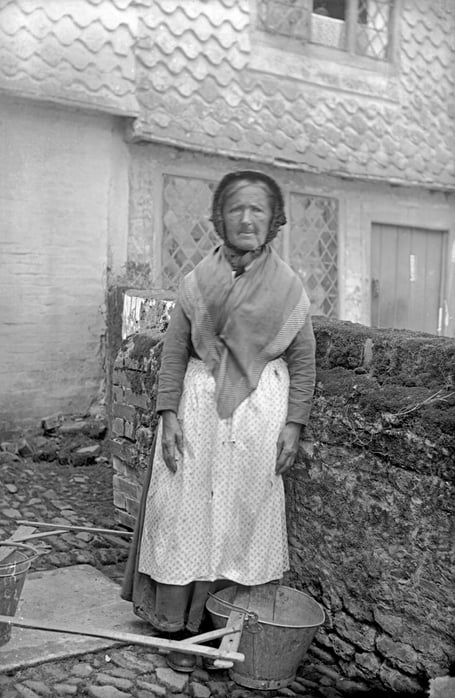
Water collection was hard, physical work, often carried out multiple times a day. Hannah Oakford is remembered as the last public water carrier in Haslemere, transporting heavy pails of water on foot to local households for a small payment. Her role marked the end of an era when water quite literally had to be carried from source to home.
We need to step back in time to 1907 to find the inauguration of Haslemere’s new, modern water supply. This development followed a report from the Hambledon Union Medical Officer of Health, which painted a rather stark picture of local conditions: “Quality doubtful, defects too many to mention… All house drains are ventilated and sewers are ventilated by tall shafts and are flushed by means of the water cart once a fortnight.”
Sounds delightful doesn't it? But this was typical of the public health concerns of the period.
The lack of a reliable supply had long been considered a constraint on Haslemere’s development, and considerable time was spent planning how to replace the scattered standpipes. Eventually, at a cost of £12,000, a reservoir was constructed high on Blackdown, more than 800 feet above sea level, on three acres of land acquired from Lord Egmont.
The engineering involved was significant for its time: two gas engines housed in an engine house powered pumps that lifted water from 107 feet underground into the reservoir. From there, the system relied on gravity, releasing water to flow the two miles into homes across the town. Apparently the fire brigade was "extraordinarily happy" at having so much water at their disposal.
But within seven years it was clear that demand was increasing and a more comprehensive scheme was required. In 1914, Haslemere Urban District Council, formed just the year before in 1913, acknowledged the need to expand provision and decided to seek “expert advice”. The tone of contemporary reporting leaves it somewhat unclear whether this included the water divining efforts of the Reverend John Sherlock Leake, vicar of Grayswood and council member, and Colonel Farquhar Glennie. Nevertheless, the pair offered to “go over Blackdown with their wands” in search of additional water sources.
This may sound slightly unusual, but this ancient method of locating water was still being used by water companies in 2017 to find leaks.
Comments
This article has no comments yet. Be the first to leave a comment.