
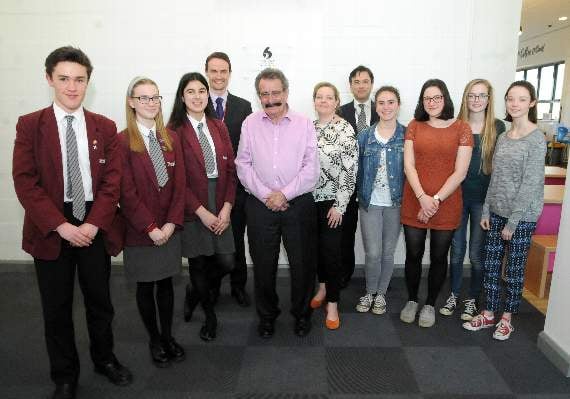
WORLD-renowned scientist Professor Robert Winston officially declared Bohunt Sixth Form open at a special launch, last week.
The visit made him miss a key Brexit vote at the House of Lords in Westminster over Britain staying in the Customs Union which he believes is necessary for stability in Northern Ireland.
After a tour of the state-of-the-art building, guest of honour, Lord Winston gave an inspiring speech entitled ‘Why Bother with Science’ to students from Bohunt and The Petersfield School (TPS), part of the Bohunt Educational Trust (BET).
“We all have to become scientifically literate,” was his key message, followed by a warning about one of the greatest threats for humanity – pandemic infections, which can spread trillions of bacteria within a very short period of time.
“This has been caused by modern technology,” he said, “mainly the way and speed with which we travel.
“The most dangerous carriers for that are aircraft and right now we are completely incompetent to deal with it,” he claimed.
Professor Winston spoke at the Liphook school about the first historic scientific experiments, which did not take place until the Renaissance in 1599, around the same time when Shakespeare wrote Hamlet and the Globe Theatre was built.
He mentioned Galileo, who famously invented the telescope in 1609 which could magnify objects 20 times, was able to look at the moon, discover the four satellites of Jupiter, observe a supernova, verify the phases of Venus, and discover sunspots, which proved that the earth and other planets revolve around the sun.
Another great discovery, he said, was made by microbiologist Alexander Fleming, who created the world’s first antibiotic substance – penicillin – in 1923, and who was awarded the Nobel Prize in Medicine.
Professor Winston stressed: “But now we have to deal with infections that are immune to penicillin and we need to be alert and find other solutions.”
He spoke about synthetic biology and generic modification which he considers are most dangerous since an attempt to modify human genes could be made.
He pointed out something as simple as taking a blood sample is a risk to that person’s identity – as it contains that person’s entire unique DNA and threatens anonymity.
The eminent scientist concluded it is impossible to legislate and protect society against scientific discoveries – and stressed we need to think about how to protect ourselves against new technologies.
He discussed with students the meaning of success – which manifests itself in many ways including a society that celebrates humanity against massive child poverty and environmental issues.
He said it was a privilege to have spent the afternoon at Bohunt, giving students exam advice and offered work experience in his laboratory at London’s Imperial College, over the sumer to those interested in medicine.
Head of sixth form Clare Hodgson told The Herald: “We were honoured to welcome Professor Winston to open Bohunt. Since we opened our doors last September, we have offered outstanding teaching, unrivalled learning environments and personalised support to them.
“It has been fantastic to see our first cohort embracing and enjoying their studies.
“We look forward to continuing to work with and support them to achieve their full potential – and to welcoming new students this autumn.”
Bohunt Education Trust chief executive Neil Strowger, who is also the school’s head, said: “The opening of our inaugural sixth form is a hugely exciting milestone and we are delighted to have welcomed Professor Robert Winston to declare Bohunt Sixth Form officially open.
“At Bohunt, we have the highest expectations of our staff and students and are relentless in our pursuit of excellence in education.
“Our commitment to and passion for science is intrinsic to Bohunt and it is fitting our students have had the amazing opportunity to listen, learn and be inspired by Professor Winston – a leading figure in the field.”
TPS principal Mark Marande added: “Our students were very excited to meet
Professor Winston and be involved in the opening of the new sixth form.
“He hugely inspired them with his passion for science, his humour and his advice for their futures and we are delighted to be involved in the sixth form.”
Bohunt Sixth Form students Molly Reckord and Maia Daborn were thrilled to meet Professor Winston before the official ribbon cutting ceremony at last week’s official opening (see page one).
Molly said: “Lord Winston was very interested in our future plans for medicine and told us our brains are extremely important – and not to hurt them. His book ‘A Child Against All Odds’ is in the library here and I have loved reading it.”
Maia added: “Lord Winston was kind enough to offer me work experience in his laboratory over the summer. I feel incredibly lucky to have met him and to have been offered this opportunity – he is a real hero of mine.”
Abi Rees, who is doing her GCSEs at Bohunt, was also keen to hear the professor speak, as she is looking at moving across to the sixth form this autumn, to study science, maths and geography.
The Professor has presented many BBC TV series including Child of Our Time, The Human Mind, Your Life in Their Hands, Making Babies, Superhuman, The Secret Life of Twins, Human Instinct, The Human Mind, Frontiers of Medicine and the BAFTA award-winner The Human Body.
He presented the BBC documentary Walking with Cavemen, a major BBC series containing some controversial views about early man but was endorsed by leading anthropologists and scientists.
Winston’s documentary Threads of Life won the international science film prize in Paris in 2005.
His BBC series Child Against All Odds explored ethical questions raised by IVF treatment.
In 2008, he presented Super Doctors about decisions made every day in frontier medicine.
In 1995, he was created a life peer as Baron Winston, in the London Borough of Hammersmith and Fulham and sits on the Labour Party benches in the House of Lords and takes the Labour whip, speaking frequently on education, science, medicine and the arts. He chaired the Lords’ Select Committee on Science and Technology and was a board member and vice-chairman of the Parliamentary Office of Science and Technology.
Comments
This article has no comments yet. Be the first to leave a comment.