
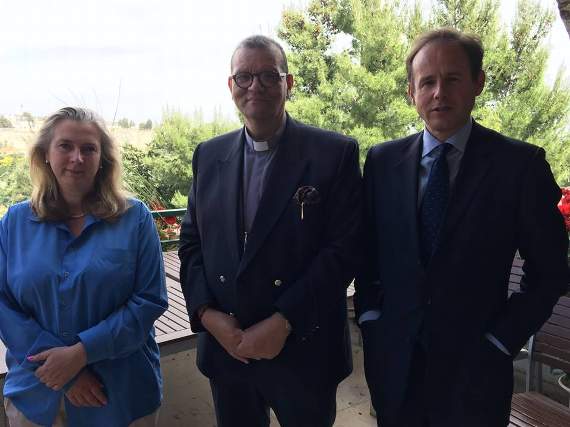
CANON Andrew White faced his own personal health crisis last month, after suffering the effects from a lack of his regular stem cell treatments for almost an entire year.
The envoy of the Archbishop of Canterbury has been barred from visiting his former Anglican church and St George’s Clinic, in Baghdad, which carries out the treatment, because of terrorist threats on his life by ISIS.
In a desperate bid to provide help, urgent arrangements had to be made to administer the treatment in a hospital in Lebanon, which included a visa application for Dr Majeed, from St George’s Clinic, to travel from Iraq.
Last week, Canon White met with a consultant hematologist at the clinic in Jordan, who, like himself, had trained at St Thomas’ Hospital in London.
 Farnham-to-Paris ride raises £100,000 for hospice
 Tens of thousands of ultra low emission vehicles registered in Hampshire – as campaigners group call for more equal access across UKThousands of ultra low emission vehicles registered in East Hampshire – as campaigners group call for more equal access across UK
.jpg?width=209&height=140&crop=209:145,smart&quality=75) My Working Week: Before burnout becomes crisis
My Working Week: Before burnout becomes crisisThe cleric told The Herald this week: “Like Dr Majeed he was a pediatric bone marrow transplant specialist and knew exactly what I needed.
“I spoke to the technician and they had the exact machine that we needed.
“The cost of all of this is in our budget. All we needed was for Dr Majeed to get his visa to come in.”
The treatment finally took place on Wednesday, this week, after which Canon White was planning to return to Israel.
He told his Facebook followers last month his health was seriously going down hill.
“I cannot get a visa to return to Iraq for my treatment and have not had my stem cell treatment since last July, after I used to have it every three months,” he said.
“After six months I was still well, but then I seriously started going down hill, after I fell and hurt myself.
“The treatment cannot be done anywhere else in the world. We have set up the stem cell treatment centre in the church clinic in Baghdad.
“The stem cells are taken from my own blood.
“The treatment is not permitted anywhere else in the world, because other places are just researching the subject of stem cell treatment, while we are doing it.”
The former Vicar of Baghdad added: “We hoped to do the treatment in Erbil, in the safe north of Iraq, in Kurdistan, but the machine we need is not working in Erbil, and there is no generator big enough in the area that would have powered this machine.
“There is a major conflict going on in Baghdad at present. Even the protected Green Zone has been infiltrated by terrorists and the government has not been issuing visas.
“Last time I needed to get to Baghdad and did not have a visa I drove down from Erbil to Baghdad – but now much of the area you have to drive through is controlled by ISIS.”
Canon White recently met with BBC’s religious affairs correspondent Caroline Wyatt and Major General James Cowan, looking at the work of the Halo Project clearing land mines from a large area of the West Bank surrounding the seven churches by the River Jordan.
The seven buildings on the River Jordan, where Christians believe Jesus was baptised by John, have lain empty since 1967.
The minefield was laid mainly by Israeli troops during the 1967 war, when Israel captured the land west of the River Jordan, now known as the West Bank.
The Halo Trust – a British charity – is a neutral humanitarian mine-clearance organisation, involved in clearing the site. Since it re-opened in 2011, the site, believed to be one of the most important in the Holy Land, is a major place of pilgrimage for Christians around the world, attracting more than 300,000 people every year, and was visited by Pope Saint John Paul II by helicopter in 2000.
In 2014, Pope Francis went to the Jordanian site on the opposite bank of the river, before he entered Israel.
Canon White described the area as “a site of restoration as well as reconciliation and rebuilding of relationships” and he said he hoped “it will become a place where those who have hated each other can come together as friends.”
The work is expected to take between 18 to 20 months and the Halo Trust needs to raise £2.7m before demining can be completed and the area turned into a national park.
The trust, which is already involved in other mine-clearing projects in the West Bank, has spent considerable time negotiating agreements to make the sacred site safe as well as building links between fractured communities, which apart from the Israeli Government and Palestinian Authority, involves seven Orthodox denominations, which are represented by Greek, Syrian, Russian, Romanian, Coptic, Ethiopian churches as well as Roman Catholics in the form of a Franciscan Church.
For more details, visit halotrust.org.
Comments
This article has no comments yet. Be the first to leave a comment.